
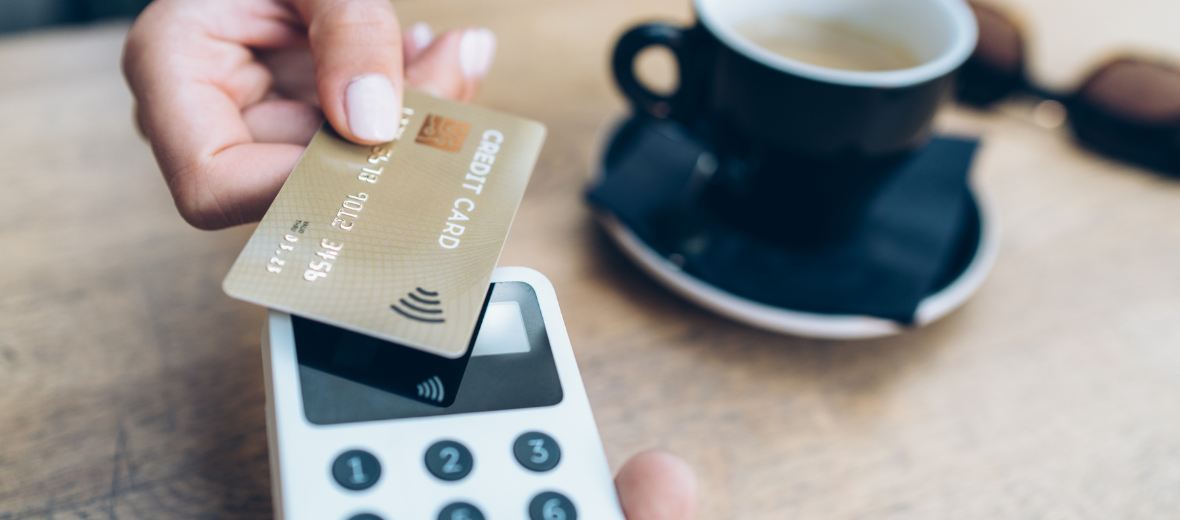
I bought a coffee this morning without really noticing I’d paid for it. Hang on, was it this morning, or yesterday morning.
Tap. Ping. Gone.
No wallet. No counting coins. No little pang of handing something over. Just a phone, a pleasant little ding, and a coffee in my hand.
Hang on, how much was it? Too late!
I’ve been noticing that ping rather a lot since.
Not because it’s annoying – it’s actually quite pleasant (certainly by design), which is sort of the problem. I suspect it’s changing how we think about spending money, without any of us really noticing.
A new client mentioned something similar a few weeks ago. As she needed to give us a breakdown of her expenditure, she’d gone through her bank statement and as a result genuinely didn’t recognise a fair chunk of the transactions. Nothing fraudulent. She’d simply forgotten she’d spent the money at all.
Which got me wondering: have we made it too easy to spend money?
There’s actual research on this, and it’s more interesting than I expected.
A professor at Cornell has spent a fair bit of his career studying why we spend differently depending on how we pay. His theory on cash is oddly charming; something about the pain of physically handing money over being almost primal, like a squirrel losing one of its precious nuts. It hurts a little. Not fatally. But enough to make you think twice.
Cards took some of that pain away. Phones took away what was left.
One study out of Warwick found that people who pay by contactless are consistently the worst at remembering how much they’ve actually spent – worse than debit, worse than credit, worse than cash by some distance. We’re not spending recklessly on purpose. We’re spending in a fog.
Nobody designed that fog deliberately, probably. But nobody’s rushing to clear it, either.
I don’t imagine anyone at Apple sat in a meeting and said, “let’s make people worse at remembering their own spending.” But it’s not exactly against their interests. The easier spending becomes, the more of it happens, and somebody, somewhere, is going to be pleased about that.
And it’s not just the tap. That same client, going through her statement, found something else: three separate subscriptions she’d completely forgotten she was paying for. A gym she hadn’t visited for quite a while. A streaming service she’d signed up for to access one film. And some kids’ paid app she couldn’t even remember downloading.
None of these arrived with a ping. They just quietly renew, month after month, until someone happens to scroll back far enough to notice.
In-app purchases work on the same principle, just faster.
A game, a subscription upgrade, a “buy now, pay later” or 30-day free trial option at the checkout – all designed so the decision takes less time than it takes to have second thoughts about it. It’s telling that buy-now-pay-later lending grew by over 1,000% in just two years. That’s not a story about people suddenly wanting to borrow more. It’s a story about borrowing becoming frictionless enough that people stopped noticing they were doing it.
Three different technologies – contactless, subscriptions, in-app purchases – and one shared trick underneath all of them: remove the friction, and the spending takes care of itself.
Here’s something that has jumped out at me.
Martin Lewis – not a man short of opinions on this – argues most of us ask the wrong question when we buy things. We ask, “can I afford this?” when the more useful question is usually, “what else could this money do instead?”
Economists call it opportunity cost. He tells a story about a friend choosing between two pairs of boots, one considerably pricier than the other, and pulling out the cash difference to show her what she was really deciding between – the cheaper boots plus a rather large stack of banknotes, or the expensive ones alone.
She bought the expensive boots anyway. You can’t win them all.
But it’s a good trick, and it works precisely because it reintroduces a bit of friction. It makes the invisible visible again, just for a second.
Which is really the whole problem in one sentence. We haven’t removed the cost of spending. We’ve only removed the feeling of it.
And feelings, rather annoyingly, do quite a lot of the heavy lifting when it comes to financial discipline.
None of this is an argument for hiding cash under the mattress again, cancelling every subscription, or deleting your apps. Tap to pay, streaming, and the odd in-app purchase are genuinely useful, and I’m not cancelling my own Apple Wallet any time soon.
But it’s probably worth the occasional moment of friction before spending money – a quick “did I actually mean to buy that?” A glance at the statement that isn’t just nodding along with whatever’s there. A once-a-year look at what’s subtly renewing in the background.
Because the danger was never really spending itself. Spending, done deliberately, is just living. The danger is spending you don’t remember making, quietly adding up in the background, while the phone keeps making that pleasant little ping.
There’s a kind of peace of mind in bringing that fog back into focus – not the guilt of tracking every penny, but the quiet confidence of knowing where your money’s actually going, and being fairly sure it’s going somewhere you’d choose.
Ask me again in twenty years whether a world of invisible spending was good for us. For now, I’ll just try to notice the ping a little more often.
📩 Email us anytime: info@charltonhousewm.com
📞 UK: +44 (0) 208 0044900
📞 Hong Kong: +852 39039004


 Production